The program was on Wildflowers and their uses. While there were only three of us at the meeting we had a great time with it. Gay Hejtmancik and I enjoyed Pam Stranahan describing to us the different uses the ancient ones of the Southwest put to Yucca and the cactus nopals that were included in the program. Her description will be added to the Yucca part of this post.
Wild onion (Allium drummondi)

Blooms March to May
The most common specie of wild onion in Texas. It is edible and quite tasty. It is one of the first signs of spring and is very pretty when seen in abundance.

Texas vervain (verbena halei)
Blooms Feb to Dec. Very pretty when seen is abundance
Since early times it has been seen as a medicinal herb and a powerful charm against witches.

Drummond phox (Phlox drummondi)
These are the pretty little flowers we see here and think spring has sprung! Their only use seems to be to cheer us up and let us know all is right with the world, seasons come and go and they tell us when.

Texas Paintbrush (Castilleja indivisa) http://en.wikipedia.org/wiki/Castilleja_indivisa
Castilleja indivisa, commonly known as Texas paintbrush or entireleaf Indian paintbrush, is a hemiparasitic annual wildflower native to Texas and Oklahoma in the United States. The bright red leaf-like bracts that surround the white to greenish flowers make the plant look like a ragged brush that has been dipped in red paint. They sometimes produce a light yellow or pure white variation mixed in with the reds.
Each plant typically grows 30–45 cm (12–18 in) in height. The leaves are long and stalkless.
The roots grow until they reach the roots of other plants, mainly grasses, and then penetrate the roots of the "host" plant to obtain a portion of their needed nutrients (known as semi- or hemiparasitism).
ed note:This was a fact that I had not known or if I had it had been forgotten over time.
Texas paintbrush typically blooms in early to mid-spring, and thrives in well-drained areas with full sun. They can be seen along highways and in fields, complementing the deep blue of the bluebonnets.

lazy daisy (Aphanostephus skirrhobasis)
Lazy daisy, Arkansas lazy daisy, Arkansas dozedaisy
Asteraceae (Aster Family)
http://www.wildflower.org/plants/result.php?id_plant=APSK
The blossom of the lazy daisy is like a smaller version of the ox-eye daisy, Leucanthemum vulgare. It grows to 2 feet high, and the flower heads are 1-2 inches across, 1 flower to a stem. The 20-45 ray flowers are 1/2 inch long, narrow, white to pink, and often deep red on the underside. The center is yellow. Leaves are alternate, 1/2-2 1/2 inches long, the lower ones sharply toothed, the upper ones smooth. Stems and leaves have soft hairs.
http://www.bio.brandeis.edu/fieldbio/Survival/Pages/yucca.html
Yucca

Yucca spp.
Family: Agavaceae or Liliaceae
Location:
native to Mexico and the Southwest United States
also found in the Eastern United States and the West Indies
Yucca Plant
Characteristics:
shrub or small tree
covered with live green leaves
usually dead brown leaves are seen on lower portion
woody plants related to lilies
Leaves:
sword-shaped and pointed
sharp brown tips
approximately 30-90 cm or 1-3 feet long
covered in numerous tiny marginal teeth
Flower:
showy and white
1-2 inches long
grow in prominent and erect clusters
Fruit:
green to black
3-4 inches long
somewhat leathery
Uses:
From the yucca leaf came fibers that were either twisted or plaited together to make cordage. Leaves were soaked in water, then pounded with stones to separate the long fibers. Sometimes human or animal hair or even bird plumage was added to the strands, which were twisted into string or ropes. These were used for belts, rope ladders, fishnets and sandals. The fibers were also used for mats and clothing and were incorporated into baskets.
The leaves were also utilized as paintbrushes by the Southwest Indians. Women chewed the leaf tip to a fine fringe which created an excellent paintbrush to use in decorating pottery.
From the roots comes shampoo, which has been used both prehistorically and historically. The dry roots were pounded by the Indians then whisked into cold water to create suds. The saponin-rich roots create a soaplike lather which can be used in cleaning.
In more recent times, Yucca-Dew Shampoo was a commercial product that utilized the sudsing agent of a yucca plant.
Shasta Rootbeer contains yucca on its list of ingredients; the yucca ingredient creates the soda's white, foamy head.
Yucca is a tree. The root of the non-flowering plant is used to make medicine.
Yucca is used for osteoarthritis, high blood pressure, migraineheadaches, inflammation of the intestine (colitis), high cholesterol, stomach disorders, diabetes, poor circulation, and liver and gallbladder disorders.
Some people apply yucca directly to the skin for sores, skin diseases, bleeding, sprains, joint pain, baldness, and dandruff.
In foods, yucca is fried like potatoes.
In manufacturing, yucca extract is used as a foaming and flavoring agent in carbonated beverages. Many compounds from yucca have been used in the manufacture of new drugs.
How does it work?
Yucca contains chemicals that might help reduce high blood pressure and high cholesterol. It might also reduce arthritis symptoms such as pain, swelling, and stiffness.
Can yucca relieve arthritis pain?
Answer
from Brent A. Bauer, M.D.
Yucca — a group of 30 species of shrub-like plants that grow mainly in dry regions of North America — is an ingredient in many dietary supplements that claim to promote joint health. Bark from the main stem (rhizome) of the Mohave yucca (Y. schidigera) is a common source of the yucca in these products.
Parts of various yucca plants have been used for centuries in traditional Native American medicine. But the only direct evidence that yucca relieves joint pain comes from a single study published in the 1970s and never validated in later publications.
Since then, scientists have isolated several yucca compounds that may turn out to have medicinal value. In the laboratory, some of these compounds display properties similar to those of anti-inflammatory drugs used to treat joint pain.
What these yucca-derived chemicals do in the test tube, however, is likely to be quite different from what they do in the human body. Scientific studies have validated many alternative and complementary therapies for arthritis, but yucca is not one of them.
References
AN01107 June 28, 2011
© 1998-2013 Mayo Foundation for Medical Education and Research (MFMER). All rights reserved.
How to Take the Luck Out of Controlling Yucca
More than 30 species of yucca grow in Texas. Yucca infests some 19 million acres of range land, mostly in the western two-thirds of the state. Some species are considered desirable. For example, Spanish dagger is an attractive plant and both deer and livestock relish its flowers and fruits. Most species of yucca, however, are considered problem plants because they develop dense stands. Species such as twisted leaf yucca may need to be controlled.
A Yucca plant has one or more whorls of leaves with a common root crown. yucca leaves are long, straight, very sharp-pointed, very fibrous, and covered with a thick layer of wax. There are no broadcast herbicide treatments for yucca, but it can be controlled with individual plant treatments.
Yucca as food:
Pam Stranahan described how the ancient Indians of the Southwest cooked the yucca root. They dug a hole approximately three feet deep. A fire was lit in the hole. The hole was lined with rock on the bottom and along the sides up to ground level. Nopals, cactus pads from Opuntia sp. were laid on the bottom, the yucca laid on top of the nopals, and more nopals were placed over the yucca. Rocks were piled on top of that and then another fire was made on the top and then soil on top of that. It was left to cook overnight in that fashion, the nopals are very watery and supplied the steam to soften the yucca root. This sounds much like the Hawaiian fashion of a luau.
Cuban-Style Yucca
Submitted By: Cocina JNOTS
Photo By: Cookin Up A Storm
Prep Time: 20 Minutes
Cook Time: 10 Minutes
Ready In: 30 Minutes
Servings: 6
"Similar to the potato, yucca or cassava is a root vegetable from Latin America or Africa favored for its versatility. In this recipe, it pairs easily with a lemon juice, olive oil, garlic dressing."
Ingredients:
2 pounds yucca, peeled and sliced
lengthwise
1/2 teaspoon salt
1/4 cup olive oil
1/2 onion, diced
4 cloves garlic, minced
1/2 teaspoon fresh lemon juice
Directions:
1. Place the yucca into a pan and fill with enough water to cover. Stir in salt. Bring to a boil over medium-high heat, cover, and cook until tender, about 15 minutes. Drain, and place yucca on a serving plate.
2. Meanwhile, place the olive oil, onion, garlic, and lemon juice into a pan. Cook over medium heat about 5 minutes. Pour the hot olive oil mixture over the yucca, and serve immediately.
Printed from Allrecipes.com 3/25/2013
Nopalitos
Nopalitos is a dish made with diced nopales, the naturally flat stems, called pads, of prickly pear (Opuntia). They are sold fresh, bottled, or canned and less often dried. They have a light, slightly tart flavor, and a crisp, mucilaginous texture. Nopalitos are often eaten with eggs as a breakfast and in salads and soups as lunch and dinner meals.
Nopalitos contain galactogamin gums which retard the absorbtion of their sugars by the digestive system and are thus considered to have a low glycemic index. They may help in the treatment of diabetes.
http://chanfles.com/comida/nopalitos/
Cooking with EL CHAVO!
How to cook Nopales! (aka Nopalitos)
Did you finally get bored of that Croissan'wich? Great! It wasn't very good for you anyways. I suggest you try some of the foods of your ancestors, you might find out the viejitos were right! In this installment we take a look at nopales, aka nopalitos, aka cactus paddles. It's the Mexican-est food there is, it even plays a role in calling out Mexicans that have turned their back on their heritage. There is a popular phrase "tiene el nopal en la frente" (he has the nopal on his forehead) which is used when some person of Mexican descent tries to deny their background, even though everyone else knows the truth; you're a commoner like the rest of us. I think I'm going to start using that phrase much more regularly, it needs to make a comeback.
Even if you don't care about it's Mexican-ness, you still might be interested in this recipe as Nopales are healthy, tasty, and cheap! They tend to remind me of cooked green beans, but more nopaley tasting. Plus you can amaze your friends with the fact that yes, you do know how to cook cactus! Besides, with the pending financial collapse we might all be forced to scrounge around in the deserts for stuff to eat and you'll have a leg up. Don't say I never did nothing for you! Enough with the wiri wiri, click ahead to get started.
I said it was cheap and I meant it: the arrow points to a recent purchase where .77 lbs adds up to only 25 cents! I think this was a sale but the average price for 4-5 paddles ranges near 50 cents these days, now that's a good deal. Hey, don't be reading the rest of my grocery bill, why you gotta be so nosy? Nah, just kidding, go ahead and look, I got nothing to hide. (I put those items on a separate bill, haha!)
Oh yeah, I should mention something about picking out your fresh nopales. As in much fruit and vegetables, it's usually better to go for the smaller sized paddles and stay away from the really large and thick ones, those should have been picked earlier and are not as tender. The most desirable ones are small, bright green, are stiffer (older nopales tend to get "floppy", give them a slight shake to see what I mean), and the spines still look dangerous and prickly, not like the example above where they've withered and turned a bit black. You can also gauge the nopales by the freshnesss of the cut at the base; if it's dry and wrinkly it was picked longer than you want it to be.
The hardest part of preparing nopales is getting rid of those pesky spines, but all you need is a knife and some patience. Cut off all the spines by slicing them off, as you see above, since you don't want to be eating those, no matter how tough you think you are. It's usually best to start from the base and work up but just get it done. It's also easier to just trim off the edges rather than try to get them off individually.
Unless you're an expert, it might get a little messy. It's a good idea to rinse them once to see if you've missed any spots.
Ta-da! Cleaned nopales without their palitos (little sticks) = Nopalitos! I love it when a term works in different ways. You've finished the hardest part, congrats!
Now to cut them into a size we can use. I start by doing some long narrow cuts lenghtwise...
...and then finish them this a' way. Since the paddles are flat it super easy to cut, I'll leave it up to you to pick a size, yer a big kid now.
This is my preferred size. I've tried grilling the paddles whole on a bbq and I've seen recipes that suggest that, but I'm not a fan of the slime. Oh yeah, did I mention that nopales are naturally slimy? I guess I should have before you got this far!
There's an easy way to reduce the natural babas though; get a pot of water boiling and throw in the nopalitos. After about 5-6 minutes of cooking you'll notice the water is thick and gooey. Dump all of it in a colander, rinse the nopalitos, bring some more water to boil and repeat. By the time you're done the nopales will be cooked and much of their natural "slime" will have been released in the boiling
water. Drain well
.
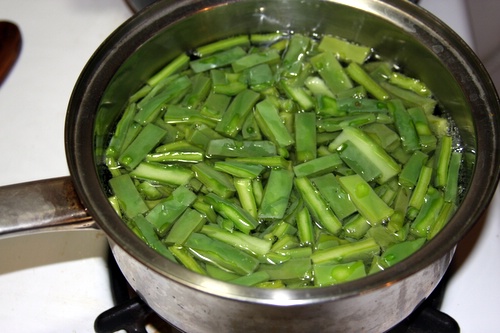
Now you have a batch of nopales ready to be prepared in your favorite recipe! I like to keep some in the fridge for a quick morning breakfast of nopales con huevos, just saute the nopales in a tad of oil with some onions and mix it in with some eggs, I'm sure you can figure that out.
But mostly I just make an ensalada de nopal by mixing some with chopped tomatoes, thin slices of white onions, fresh chile serrano, cilantro, olive oil, salt, pepper, and some fresh squeezed limes. This time I also had some queso fresco available so I threw in some chunks, but it certainly doesn't need it, especially if you want to keep it vegan. The picture is kinda lousy but the salad is refreshing, goes great on tortillas and tostadas, and it's easy to make. It's best to eat your prepared nopales quickly as they will still release some babas. Not a bad way to spend a quarter!
I hope you give it a try. Provecho!
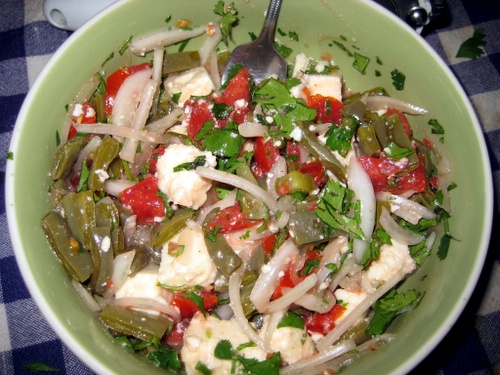 Ensalada de Nopal
Nopalitos with Tomato and Onions
Ensalada de Nopal
Nopalitos with Tomato and Onions
Nopalitos, chopped prickly pear cactus paddles sautéed with onions, garlic, jalapeno, and tomatoes.

Prep time: 5 minutes
Cook time: 15 minutes
Ingredients
1 lb nopalitos, nopales prickly pear cactus paddles that have been stripped of spines, cleaned, and chopped
Olive oil
2 large cloves garlic, minced
1/2 red onion, roughly chopped
1 jalapeño pepper, stem and seeds removed, chopped
1 medium tomato, roughly chopped
Salt and pepper
Method
Heat a tablespoon of olive oil (enough to coat the bottom of the pan) in a large sauté pan on medium high heat. Add red onion, garlic, and jalapeño. Cook for a minute, stirring occasionally, then add the nopalitos. Cook for several more minutes. Then add the chopped tomato. Continue to cook until all vegetables are cooked through. Season with salt and pepper to taste. Serve immediately.
Yield: Serves 3 to 4. Simply Recipes
http://www.simplyrecipes.com
So there you have it. I haven't tried these recipes, I am planning to. They look good to me, especially that ensalada. Can't wait to try it.


